Kendall Hokes
As the state legislature’s delay in passing the budget causes discontent across the state and new congressional maps redraw who’s in power, North Carolina State Rep. Zack Hawkins wants students to know they have more power than they realize.
“If every North Carolina Central student in Durham voted, they would shift the power of elections in the city, state and beyond,” he said.
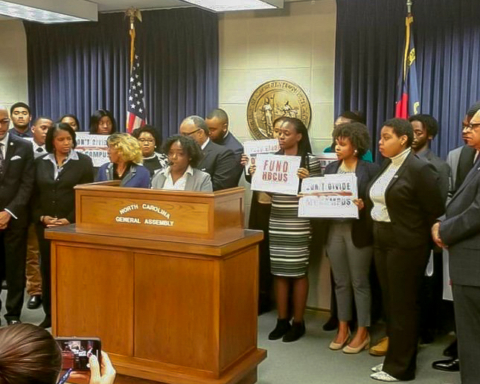
Hawkins has represented the 31st district of North Carolina since 2019, which includes N.C. Central University and Southeast Durham. Hawkins spoke to the Campus Echo as a “proud” alumnus about the importance of passing the six-month overdue state budget for North Carolina’s higher education institutions, especially its HBCUs.
“It is the pleasure of my life to focus on HBCUs and make sure they have consistent advocacy,” he said.
The North Carolina General Assembly has still yet to pass a state budget, which was due July 1. According to Hawkins, the budget is unlikely to pass before March 2026.
The budget funds expenses like state infrastructure, higher education and state government employee salaries. But a standoff between Republicans and Democrats, and House and Senate Republicans, have left budget negotiations at a standstill.
Hawkins said that though the Republicans have a majority in the House and nearly supermajority in the Senate, their differences in ideology about how the budget should take shape have been adding to the hold-up.
“The Senate is really focused on cutting taxes, which a lot of people believe would put North Carolina in a deficit of $800 million a year,” he said. “But the House is saying we’ve cut enough taxes and we’re worried that these deficits will not allow us to continue to support state infrastructure.
The General Assembly garnered more controversy after its recent passage of a new congressional map ahead of the 2026 midterm elections, raising concerns from voters and advocacy groups about partisan gerrymandering. Hawkins, who voted against the map, says this reflects upon the issues that arise when any one party has too much control.
“Everyone should have the ability to participate in the democratic process fairly,” he said. “There shouldn’t be a predetermined outcome in an election.”
Hawkins describes these new maps and the motivation behind redrawing them with “surgical precision” as purely political.
In October, lawmakers approved the new congressional map with a 66-48 vote in the House and a 26-20 vote in the Senate, following a larger trend as Republican-controlled state legislatures redraw congressional maps ahead of the 2026 midterm elections.
The new map focused on reshaping District 1 which includes much of eastern North Carolina, likely bringing the state’s representation in the U.S. House of Representatives to an 11-3 Republican majority.
Looking ahead, Hawkins said getting the budget passed, securing funding for higher education institutions across the state and positioning North Carolina as a leading state in AI innovation are among his main priorities for next year’s short legislative session.
“The first thing to do is to get the budget passed. Many people are struggling and they need this money,” he said. “Next, we need to secure that funding for NCCU and other HBCUs, and we need to have a continuous focus on the AI council.”
Hawkins said that he urges NCCU students and all young people across the state to amplify their voices, speak out about the causes that impact them and to vote in every election.
“Raise your voice, create ideas, put yourself out there for volunteering and action on a particular issue,” he said. “It’s during the toughest times you should get activated so you can make sure you don’t ever feel that way again.”