 Sanya Providence
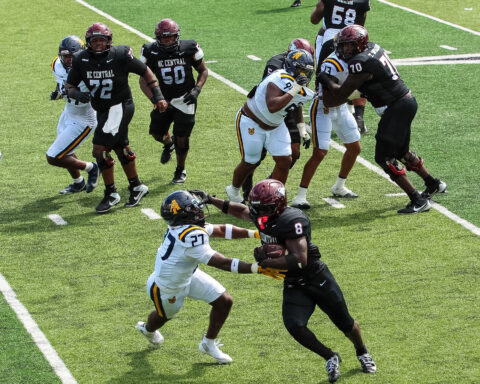
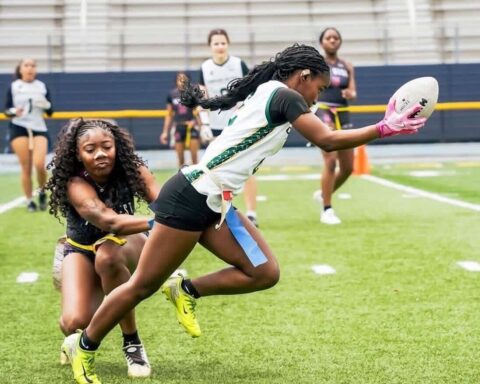
For the women on the N.C. Central University club flag football team, the game has always been more than just weekend tournaments. It’s been a fight for legitimacy.
Now with a new NCAA designation, that fight could finally put them on the field they desire.
In January, all three NCAA divisions approved adding women’s flag football to the NCAA Emerging Sport for Women, recognizing its fast-growing popularity among women’s sports. This new designation means NCCU now has the pathway to elevate the team from club to varsity status with increased sponsorship and institutional support.
Founder and head coach Jaquan Milliam said that he has watched the program grow from an idea into a competitive club. While he acknowledges that the support “could be better,” he believes this designation could finally be the turning point for the team.
“With the NCAA doing this, it gives them the opportunity to possibly be on scholarships,” Milliam said.
For players like Myki’ra Haley, who has dedicated years to the sport since her teenage years, this decision feels overdue.
“I’ve played for years in high school,” Haley said. “I’ve been waiting for this.”
Her teammate, Aliza Taylor, echoed this feeling, emphasizing that the team is ready for the “spotlight” that comes with the official NCAA status.
Since the 1970s, NCCU has progressively opened opportunities for women athletes, adding sports like volleyball and basketball to the athletic program. The flag football team hopes to follow in the footsteps of these sports, all of which successfully transitioned to Division I in 2007.
NCCU currently sponsors seven NCAA Division I women’s teams as a member of the Mid-Eastern Athletic Conference: volleyball, basketball, softball, track and field, cross country, tennis and golf.
Kwadjo Steele, the university’s associate athletics director for student-athlete support, explained that while the NCAA’s Emerging Sport designation can enhance a student’s experience, transitioning to varsity status requires long-term funding.
“Funding programs takes money over time, so you want to have enough money that the team can, have a place to play, they can travel, they can have uniforms,” Steele said. “And so those things need to not be sustainable for just one year or maybe two. You want to make it sustainable for a long time.”
Compared to varsity, club sports have limited field and gym space, as well as equipment, making scheduling and practice difficult for coaches and players. Because recreation equipment is shared among multiple intramural sports, maintaining accountability can be challenging.
“We have the equipment, but it’s hard to allow others to use the equipment because it won’t get returned either in the same condition that it was given or something will go missing,” said Jasmine Reddick, facility operations coordinator for recreation and wellness.
Since its founding in 2023, the flag football team has had to organize its own practices and tournament schedules, while also fundraising for travel and gear. Through grassroots fundraising events like “Pie the Player,” where supporters pay to throw whipped cream pies at players, the team has dedicated hours and resources to keep the program afloat without university funding.
“There are times where I have to take money out of my pocket to make sure that we have stuff we need for us to keep playing, for us to pay for referees and any equipment we need,” founder Milliam said.
The team continues to practice weekly and compete in tournaments. For their schedule, see below:
March 28 – Bull City Bash Tournament at NCCU
April 2 – Game against Ferrum College at NCCU
April 12 – Queen City Classic at UNC Charlotte University
April 18 – Tiger Town Showdon at Clemson University