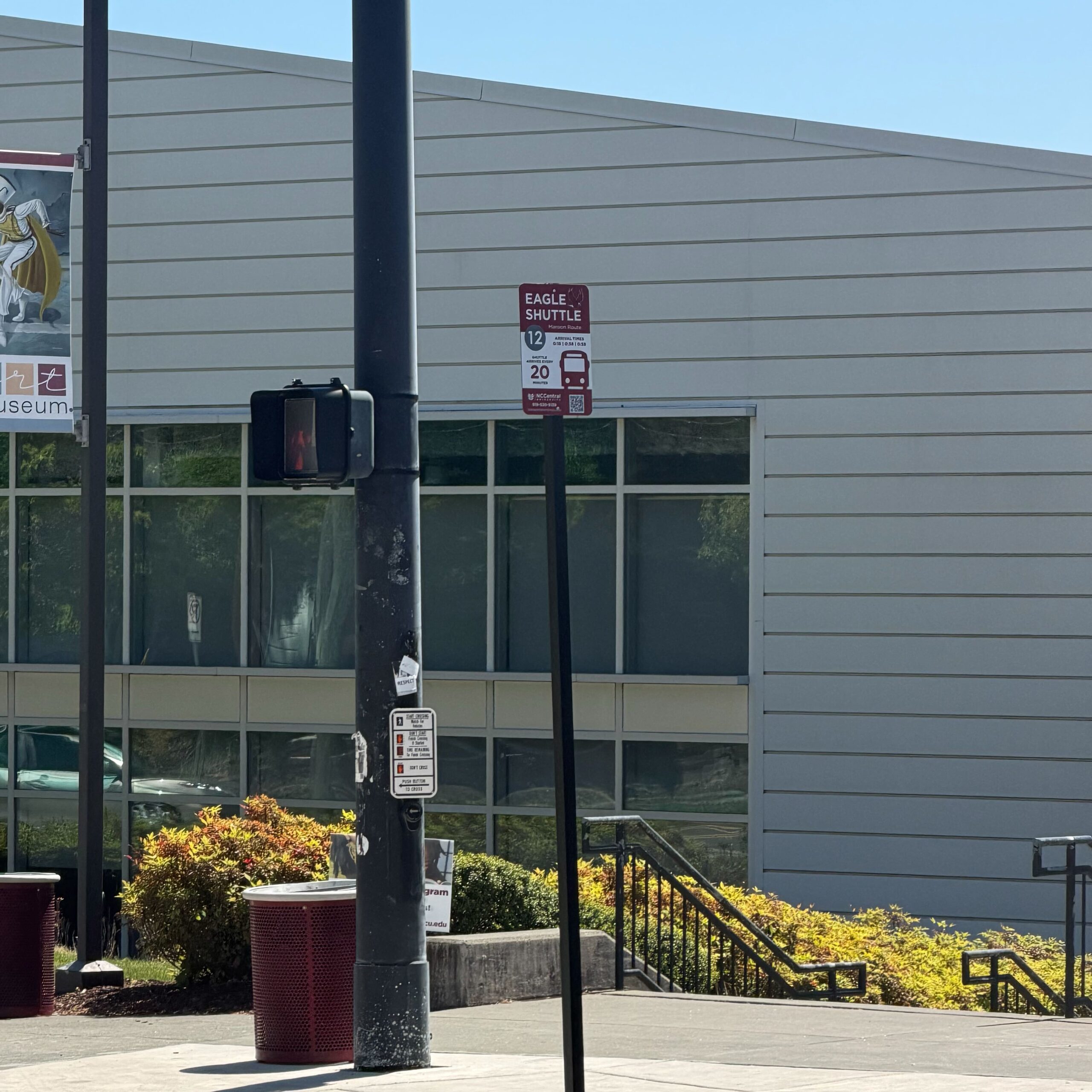
N.C. Central University debuted a new Eagle Express Shuttle Service route for commuter students on March 3 via PassioGO! in its ongoing effort to improve transportation to and from campus.
“Students [were] calling, trying to get transportation to campus, and we didn’t have anything,” NCCU Transportation Demand Management Coordinator LaTresha Harwell said. “So, we talked about it and decided to see what we could come up with.”
What they came up with was an off-campus route that could be run on both the Maroon and Gray shuttles, which would allow commuter students living in off-campus housing to travel to and from campus, the cost of which would be included in their transportation fee on their e-bill.
That cost could rise to $103 from $63, but most of that increase would be funneled into compensating drivers and maintaining the quality of transportation, and would not be implemented until next school year, according to NCCU SGA President Sha’Lexus Sanders.
The new route services students and off-campus communities within a three-mile radius and runs from 7:00 am to 9:00 pm on Mondays through Fridays and 8:00 am to 5:00 pm on Saturdays.
In partnership with NCCU Student Government Association and Student Affairs, NCCU Transportation emailed a survey to off-campus students to determine ideal times and highest-demand areas in need of the new route.
“Right now we have a list of the housing that students live in, and so right now we’re accommodating all of those,” Harwell said.“They just have to call and go through PassioGO.”
Harwell said transportation is still registering students for PassioGO! and helping them set up pickup and drop-off times in the app. As of Monday, only 215 students have registered.
Transportation for students who live off-campus was an issue that SGA wanted to address this year.
“I knew just how much of an inconvenience that was for me,” NCCU SGA Campus Safety and Transportation Liaison Xavier Fenner said.“So I just wanted to set up this kind of system that would be good for off-campus students to get to campus in a safe and sufficient manner.”
Fenner, a third-year criminal justice major, also said that off-campus shuttle routes were something he brought up previously to SGA President Sha’lexus Sanders, but that she didn’t have the time to “put pen to paper.”
Therefore, he helped in taking the initiative to bring up the issue of off-campus transportation to NCCU’s administration.
The route was initially expected to be implemented next fall semester, but the increasing need for off-campus transportation pushed the date up to this spring.
“Eagle Express was originally projected to be implemented after my term, but because the need was so clear and consistently advocated for, the university moved with urgency,” Sanders said in a statement. “Which speaks to the responsiveness and commitment to student concerns.”
Sanders also said her main priority in establishing the route was “safety and accessibility,” and hoped this route could provide off-campus students with a “reliable, university-supported option” for transportation, and commended Fenner for his efforts.
“I am also proud of Xavier Fenner for his work as Campus Safety and Transportation Liaison,” Sanders said. “This was a collaborative effort, and we both played a strong role in advocating for this initiative and pushing it forward for the betterment of our university.”
For students, having off-campus transportation could not come at a better time, as gas prices continue to rise in the United States amid its conflict with Iran, with the national average approaching $4 a gallon, according to the American Automobile Association.
“I had a friend named Kiya [who] actually had to take this year off because she wasn’t able to get transportation to school, and she had to keep paying for Ubers and Lyfts, and that racks up,” senior Rachel Barnes said.
Fenner was skeptical about believing rising gas prices were the main reason why off-campus students were commuting to school.
“I do, but at the same time, I don’t because what I learned from college students is that if they really wanted to, they [would],” Fenner said. “That even goes [for] class, if they really want to go to class, then they will.”
Barnes also said that despite it being her last year, commuting off-campus had not been more convenient for her, as compared to some seniors who may not attend as many classes on campus as they approach graduation.
“You’re less involved about what’s going on in campus life because you’re at home,” Barnes said. “Like, what’s the point of me coming to class and then going home, and then [if] there’s an event on campus. I don’t even want to go because I’m already home.”
Gas prices are not the only issue that students have, though, as distance is something that has inconvenienced students, as well.
“I stayed where Campus Crossing used to be, so that was like ten minutes driving, but on the bus it was like a cool hour,” sophomore Mckenzi Lee said.
“Maybe a little less than that, but it was long. I don’t think three miles is enough, maybe like five or six.”
Barnes also shared that sentiment and said she felt the radius should be expanded to at least five miles.
The issue of off-campus transportation is one that the transportation department hopes to improve, as well as other related transportation issues.
“I feel like the students [who] live off campus can actually save some money, [and] instead of getting the commuter parking pass,” Harwell said. “Just sign up for this service to cut down on the congestion, them being stressed, and worried about parking somewhere they shouldn’t and possibly getting a ticket.”
Harwell said that Transportation hopes to at least have half of NCCU’s 9,281 student body registered with PassioGO!
By the end of the year and has plans to expand the three-mile radius of the current route by adding more routes in the future, including some to Duke University, so nursing students and other students can get to their classes.
“Eagle Express has the potential to significantly improve the student experience by increasing safety, reducing parking strain, and making off-campus living more accessible,” Sanders said. “It is a meaningful investment in student success, and I am proud to have played a role in helping bring it to life.”