 Christian Newell
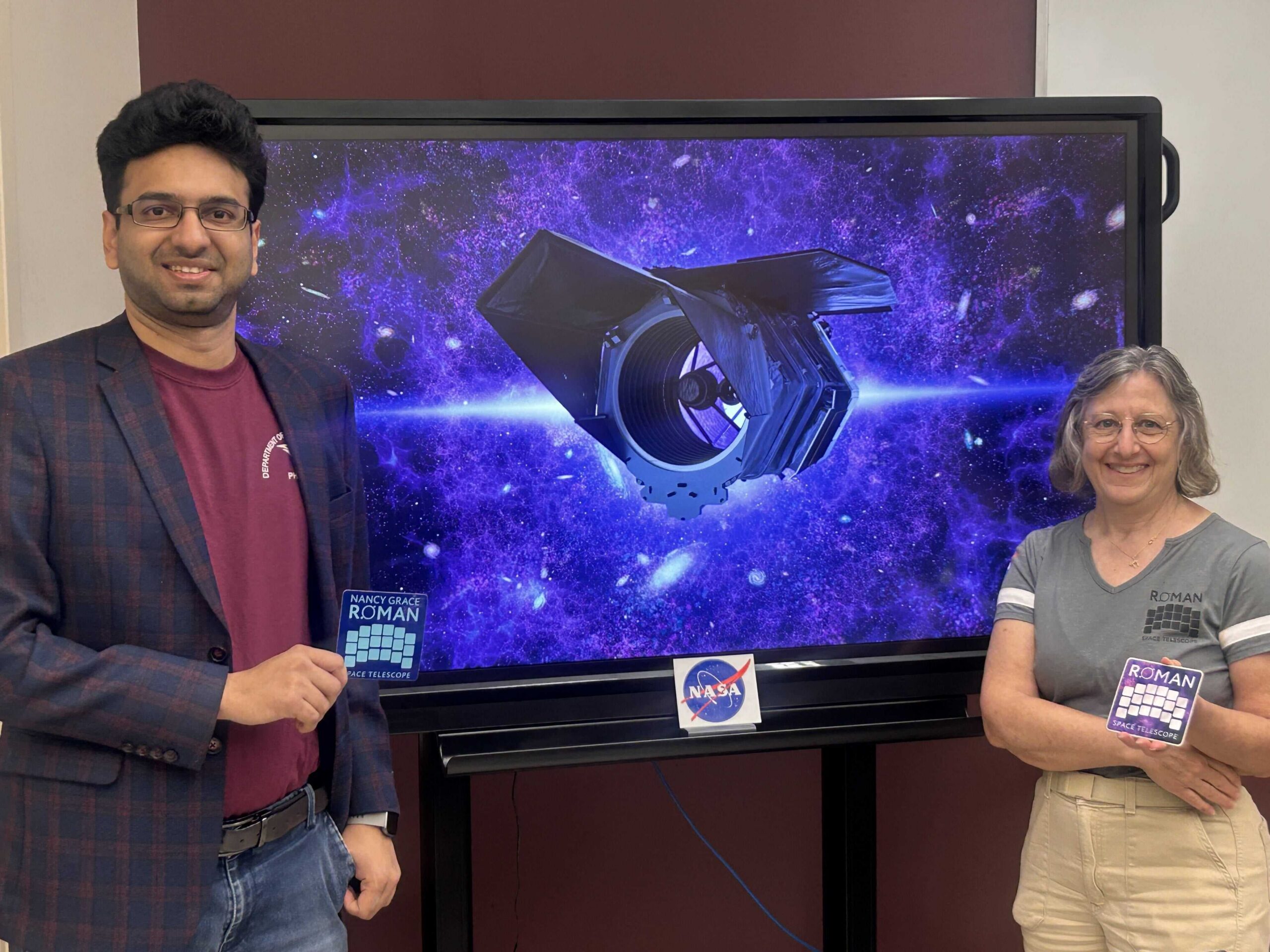
N.C. Central University collaborated with 13 other institutes, such as Penn State, Duke University, and Ohio State University to develop software for NASA’s Nancy Grace Roman telescope.
Professor of Mathematics and Physics Diane Markoff said NCCU researchers are helping work with information collected by the telescope detectors and turn that raw information into data that scientists can use to study our galaxy and the universe.
NCCU’s portion is supported through a $700,000 subaward from Duke, which is now in its third year of the project. But rather than helping build the telescope itself, NCCU is only one part of five project infrastructure teams responsible for processing Roman’s raw data into usable scientific information. Markoff said NCCU’s team is mainly focused on preparing data to study supernovae.
“Our role is working with colleagues and big group collaborations, and we’re working with people to take the data that comes directly from the telescope,” Markoff said.
During the first three years of the project, NCCU researchers have been developing software to interpret Roman’s data and identify supernovae within images containing much brighter galaxies. Researchers have used test data collected before the telescope launch to develop the software, which will now be tested against commissioning data collected in space. Markoff said the team must account for characteristics of the telescope detectors and other distortions before researchers can accurately interpret what they are seeing.
“We take information that is from the telescope, and we take the data, and we process it into something that is useful for science,” Markoff said.
This software is a wide field instrument, which collects light from distant space objects. The light collected is recorded and turned into pixel data – what researches call the “pixels to cosmology process.” The researcher’s job is to account for how the detectors captured that information before they can interpret what they are seeing.
“Our role is working with colleagues and big group collaborations, and we’re working with people to take the data that comes directly from the telescope,” Markoff said. “And then turn that into something that we can learn about cosmology.”
However, for NCCU, this work is only just the beginning.
Markoff has said that NCCU is also pursuing a separate NASA grant that would allow NCCU researchers to use machine learning to improve the way scientists calculate photometric redshifts, or “photo-z.”
This redshift technology assists scientists to determine whether an object in space is moving away from or toward Earth; that information can help researchers understand the distance and movement of distant galaxies.
With the Roman telescope expected to collect an enormous amount of data, researchers believe machine learning could help process and categorize that information more efficiently.
“We put in a proposal for that grant, and it looks like we’re gonna get it,” Markoff said, while noting that the funding had not yet been officially confirmed.
This grant would allow NCCU researchers to develop a software pipeline that uses machine learning to analyze light from distant galaxies and improve estimates of their redshifts.
Dr. Atul Kedia, an assistant professor in NCCU’s Department of Mathematics and Physics, said the proposed project could give NCCU a new avenue for astrophysics research.
“If it is awarded, we will be developing this statistical pipeline of taking the data and analyzing the wavelength and light data that’s being collected,” Kedia said.
This research could also help scientists study larger questions about how the universe has changed over time. More accurate measurements of distant galaxies could contribute to research surrounding galaxy formation, the expansion of the universe, supernovae,, and dark energy.
For Kedia, the project is also about building something that could last beyond the Roman mission.
NCCU is working to develop an astrophysics program, and Kedia was recently hired to help build it.
Markoff said Roman has provided an important starting point for expanding the university’s presence in astronomy and astrophysics.
“If we get this grant, it shows and puts NCCU on the map for astronomy and astrophysics,” Markoff said.
The connections that NASA can bring could become increasingly important as NCCU develops its astrophysics program. Markoff said the university has had students interested in astronomy in the past but has not always been able to provide the same level of research opportunities available at universities with established astrophysics programs.
Markoff hopes the program will attract more students interested in astrophysics while expanding the courses and research opportunities available to them.
“We hope we will bring in more students that are interested in astro and be able to provide meaningful courses and research opportunities,” Markoff said.
As the Roman Space Telescope begins its mission, NCCU’s involvement could expand the university’s research capacity, provide students with opportunities in astrophysics, and help establish a foundation for future cosmology research. While the telescope operates in space, NCCU faculty and students will bring the mission data and research opportunities back to Durham.