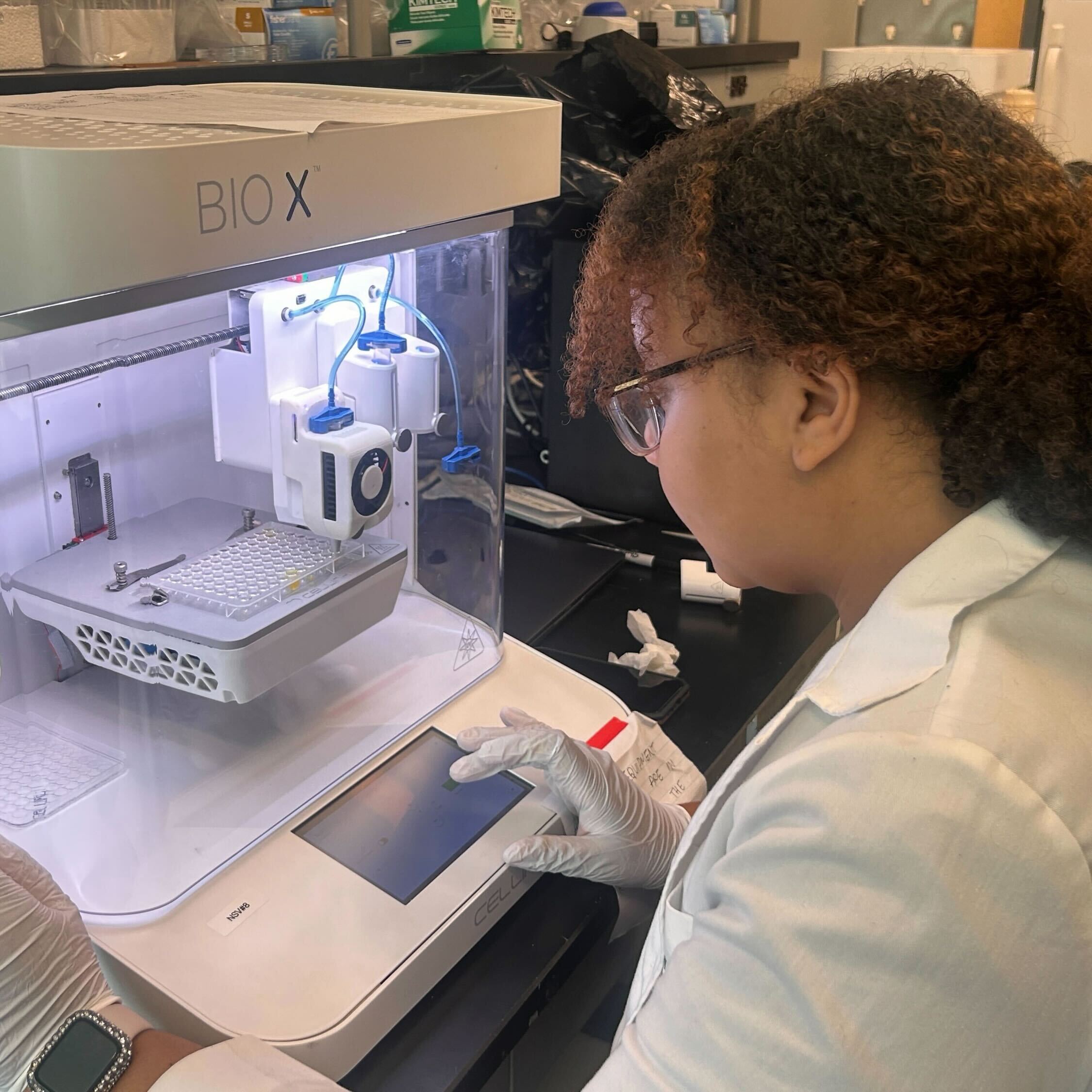
The N.C. Central University Fab Lab has opened its gates to students to have hands-on experience with bioprinting, thanks to a $1.4 million federal investment that pushes students to evolve the field of research.
Eric Saliim and Nicole Salazar have secured the $1.4 million grant from the National Institute of Health as part of an effort to advance bioengineering and technology at the college level.
That technology is capable of recreating human tissue for research and testing.
“The funding provides us with the infrastructure to set up a platform for students to get involved in bioprinting,” said Eric Saliim, program manager of the NCCU Fab Lab.
Bioprinting works by using specialized 3D printers to layer living cells and biomaterials, building structures that mimic how tissue behaves in the human body.
Instead of testing drugs on animals or flat cell samples, researchers can study diseases in a more without putting animals at risk
This means that researchers and scientists can better understand how cancer, bacteria and cells interact with treatments before they reach human trials.
That work is already underway at NCCU. Students are using bioprinting to create 3D tumor models that replicate how cancer grows and responds to treatment.
Dominica Lee, a business graduate student at NCCU who returned as an undergrad in biology, said her team bioprints small spheres using bio-inks made from materials like collagen and combines them with breast cancer cells.
“The goal is to make them behave like tumors you would see in the human body,” Lee said.
Her research focuses on using cancer cells from minority women—an area often underrepresented in traditional studies.
“Most research is based on European populations,” she said. “So we’re expanding the knowledge of how cancer behaves across different groups.”
Those models allow researchers to test treatments in a controlled, human-like environment without relying solely on animal testing.
“We’re creating models using human cells, without causing harm, and testing treatments in a way that’s more directly relevant,” Lee said.
Researchers say this approach could lead to more accurate results and a broader understanding of cancer across different populations, while giving NCCU students early access to a field that is still evolving.
“There are still limitations,” Saliim said, explaining that widespread use in hospitals, especially for drug development. [It] could still be 10 to 20 years away.”
Tradition is another barrier.
“Historically, research has been based on animal models where they take, you know, rats, hamsters, gerbils, fish, and monkeys,” Saliim said. “They take all of these various animals and run these tests.”
For years, medical research has relied on animal testing. Transitioning to bioprinted models means challenging that standard and proving that these new methods can deliver more accurate results.